
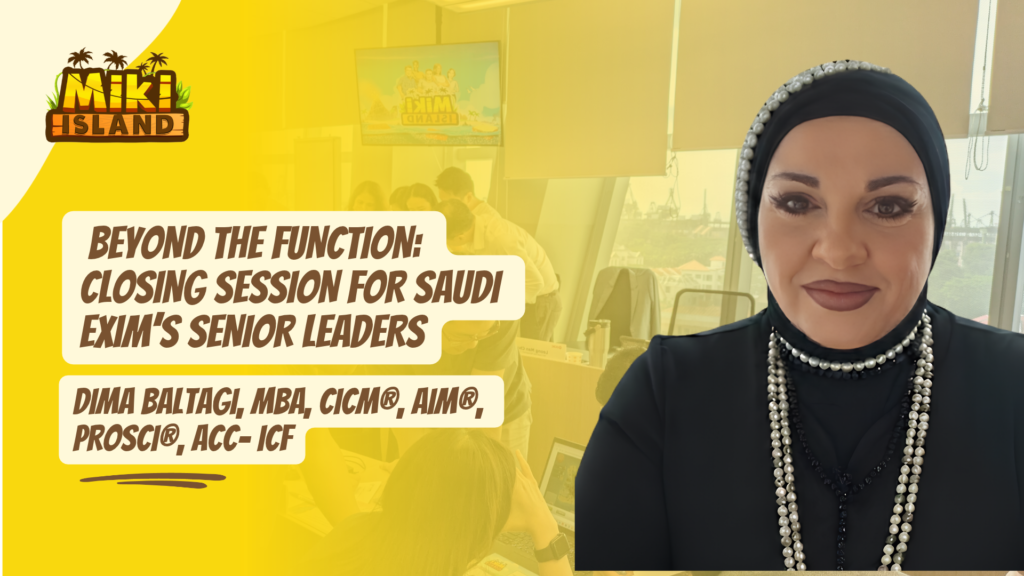
Beyond the Function: Dima Baltagi’s Closing Session for Saudi EXIM’s Senior Leaders
Key Takeaways
- Saudi EXIM took 20 senior leaders through Beyond the Function, the module on turning strategy into practical action, and used Miki Island to close the program.
- The module strengthens three things together: strategic thinking, enterprise-wide decision-making, and collaboration that crosses functions.
- Miki Island’s debrief asks a group where it fell back on silos — the module’s own subject, pointed at the group’s own behaviour rather than the organisation’s.
- Dima Baltagi delivered the closing session in Saudi Arabia.
Organisations rarely stall because nobody wrote a strategy. They stall at the point where the strategy has to survive contact with the org chart — where a priority that is obviously right for the business has to compete with a priority that is obviously right for your own function.
Saudi EXIM built a module around that exact point. Twenty senior leaders worked through it in Saudi Arabia, and Miki Island closed the program.
The module is not called Beyond the Strategy. It is called Beyond the Function, and that is the harder of the two.
Where Strategy Usually Stalls 🔄
Beyond the Function is the second module of Saudi EXIM’s program. It is designed to help Saudi EXIM teams translate strategy into practical action, and it does that by strengthening three capabilities side by side: strategic thinking, enterprise-wide decision-making, and cross-functional collaboration.
Those three belong together. Strategic thinking on its own produces a sharper analysis. Enterprise-wide decision-making on its own produces a sounder decision. Neither one travels far unless the functions around it are willing to move with it.
The objectives behind the module are specific. Leaders should be able to take Saudi EXIM’s strategy and turn it into actions their own teams can get on with. They should be able to weigh a challenge through a systems and enterprise lens rather than a functional one, and to see the strategic value in collaboration that goes through silos instead of around them.

Behaviours in Focus 💡
Ideas about teamwork are easy to agree with. Behaviour is harder to see, and that is where Miki Island puts its attention.
Under pressure, habits show: how a team shares information, who takes ownership, how decisions get made.
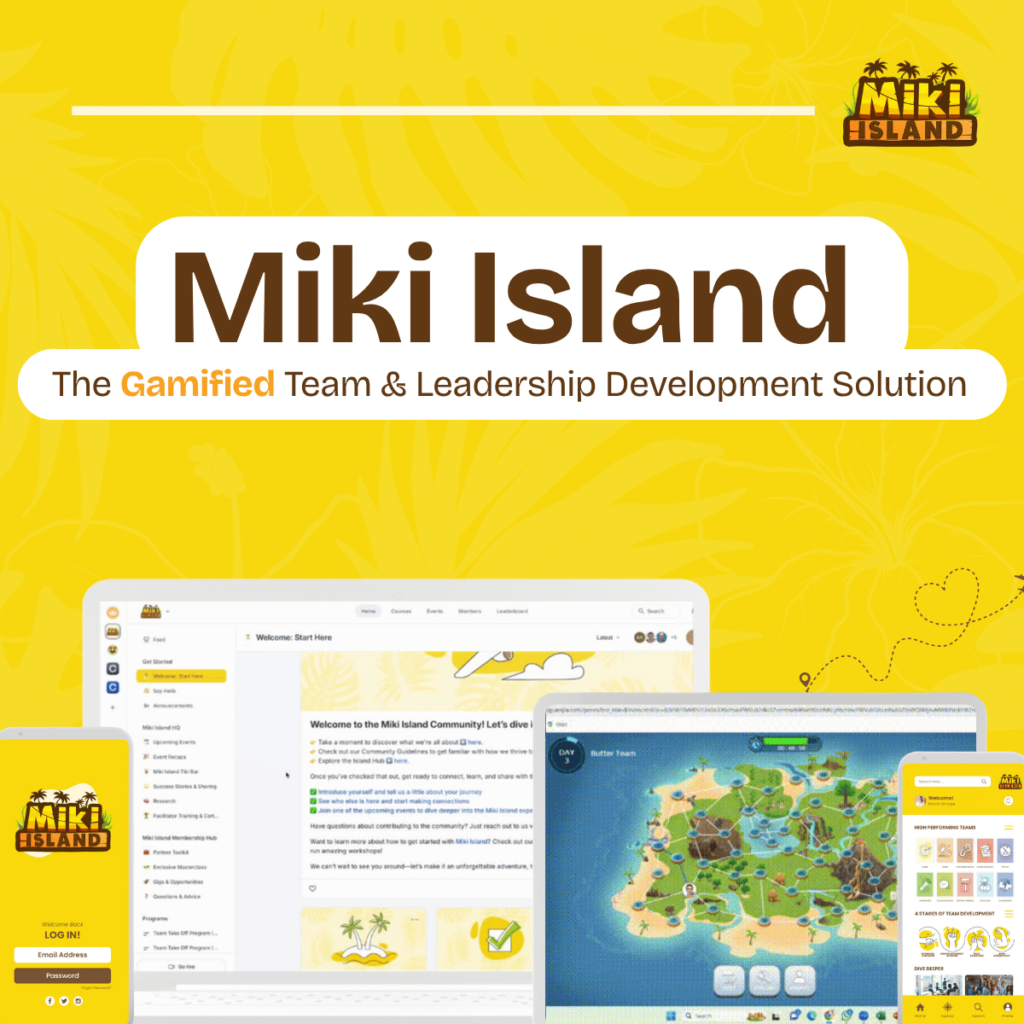
Miki Island’s research describes how teams behave as they mature, and the work is about practising those behaviours:
🤝 Shared ownership
🧠 Collective intelligence
📣 Healthy challenge
🎯 Clarity and alignment
⚡ Fast learning loops
A coach guides the reflection with plain questions.
What just happened?
Where did the team fall back on silos?
Who took ownership, and who waited?
This describes how Miki Island works in general. What BRI’s leaders saw in themselves is theirs to tell.
When a decision is genuinely difficult, they should have an analytical framework to reach for. And their function’s priorities should line up with the organisational maturity Saudi EXIM is working toward.
The module does not try to teach that from a slide. It runs on practical frameworks, relevant examples and applied activities, so the thinking gets used while people are still in the room.
Dima Baltagi: Closing the Program 🤝
The session was delivered by Dima Baltagi in Saudi Arabia.
Placing Miki Island at the end of the program rather than the start is a choice worth noticing. By that point the frameworks are already on the table, and the open question is no longer whether the group understands enterprise thinking.
It is whether they reach for it when something actually has to be decided together.
What the Simulation Is Built to Make Visible 🏝️
Inside Miki Island, a group gets one task and not quite enough to go on. Decisions have to be made with gaps in what people know, and nobody holds enough on their own to work it out alone.
What that produces is not drama. It is ordinary behaviour, slightly compressed. The habits a team carries into an average working week show up quickly, because the conditions that trigger them are all present at once: partial information, a decision that will not wait, and other people whose agreement you need.
For a module about looking past your own function, that compression is the point. A silo is almost impossible to see from inside it while the work is going fine. It becomes visible the moment a group needs something sitting in someone else’s lane and has to go and get it.
What the simulation is built to make visible:
🧠 Where a group’s information sits, and whether it reaches the person making the call
🤝 Who picks up a decision, and who leaves it for someone else
🔄 What a team does with a plan that has stopped working
🎯 How long a shared goal survives contact with the detail
What the Debrief Opens Up 💡
The simulation is only half of the method. The other half is a coach walking the group back through what just happened, which is where behaviour becomes something a team can talk about without it turning personal.
The questions are plain ones.
What just happened?
Where did the team fall back on silos?
Who took ownership, and who waited?
That middle question is this module’s own subject, pointed at the group instead of the organisation. It is one thing to agree that silos cost an enterprise money. It is a different thing to look at a decision your own group made twenty minutes ago and find one in it.
Asking it that way takes the accusation out. The group is not arguing about whether silos exist. They are describing something they all watched happen.
What Miki Island Adds to a Module Like This
✨A module can leave a group genuinely convinced. Conviction is not capability, and what usually sits between the two is behaviour.
What a simulation adds is something the whole room went through together and remembers the same way. After it, a conversation about working across functions has something solid underneath it — not a principle everyone nods at, but a specific moment several people can point to.
Beyond the Function, in Practice 🚀
The ambition behind Beyond the Function is written into the module itself: leaders who can translate Saudi EXIM’s strategy into priorities their own teams can act on, prioritise initiatives by strategic value and impact, and convert a direction into SMART objectives that somebody owns.
None of that is a thinking problem on its own. It is a deciding-together problem, and it gets solved in the places where functions meet.
Saudi EXIM closed the program on exactly that note, with Dima Baltagi and Miki Island.
Twenty senior leaders, one organisation, and a module that asked them to see past their own part of it. 💛
Conclusion
- No module settles how a leader behaves when their own function’s priorities and the organisation’s pull apart. Beyond the Function gives them the thinking to spot that moment, and Miki Island closed the program by putting the group through one with a coach in the room.
