
Date: April 7, 2026
Location: Singapore
Context: Need for better decision-making, alignment, and collaboration
Objectives: Understanding the team’s own and individual strength patterns and how to utilize them in the way they work together.
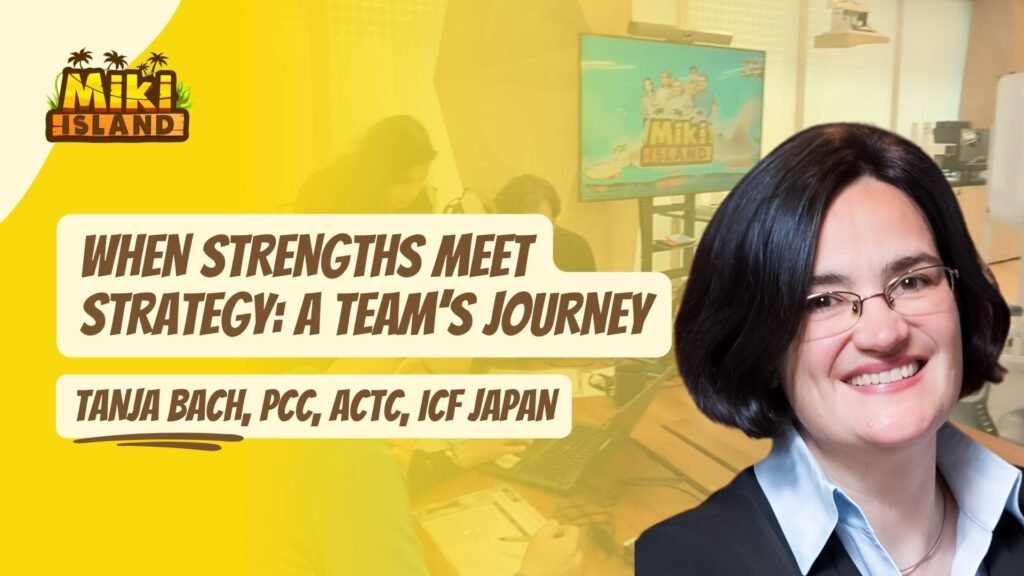
Partner: Tanja Bach, PCC, ACTC, ICF Japan & Miki Island Partner From Japan
When Strengths Meet Strategy 🌱
Great teams are rarely built from identical people. They’re built from different minds that have learned to move together. That was the quiet premise behind a workshop held on the 7th of April 2026 in Singapore — a session designed not to fix what was broken, but to illuminate what was already there, waiting to be understood and better used.
The Starting Point 🔄
The team came in with a real and honest challenge: decisions were taking longer than they should, alignment felt harder to reach than expected, and collaboration — while present — wasn’t always flowing. Not a crisis. But a friction that, left unexamined, tends to quietly limit what a team can achieve together.
The question wasn’t what was going wrong. It was why — and more importantly, how each person’s natural patterns were shaping the way the team moved as a whole.
Tanja Bach: Bringing the Experience to Life 🤝
The session was designed and facilitated by Tanja Bach, a certified Miki Island partner based in Japan, whose work spans team development, leadership, and behavioural insight across Asia.
Tanja brought both the Miki Island simulation and a clear developmental lens to the room — creating a space where participants could do more than play. They could observe themselves, see each other clearly, and begin to make sense of the patterns that had been shaping their daily work without anyone quite naming them.
What the Simulation Revealed 🏝️
Inside the Miki Island scenario, the team’s dynamics became visible almost immediately.
Under pressure and ambiguity, individual strength patterns surfaced naturally:
🧠 How each person processes uncertainty — and how that affects group decisions 🎯 Where risk appetite varies, and how that creates invisible friction or unexpected momentum 🔄 Who moves fast and who moves carefully — and why both matter 🤝 How alignment is reached, delayed, or quietly assumed without being genuinely achieved
These weren’t critiques. They were data points. And seeing them clearly, in real time, gave the team something far more useful than feedback: it gave them shared language.
The Aha Moments 💡
The debrief opened conversations that the team hadn’t quite had before — not because the willingness wasn’t there, but because the shared reference point hadn’t existed.
Once it did, things shifted.
Participants began to see that what sometimes looked like resistance was often a different risk appetite. That what felt like misalignment was sometimes two people optimising for different things, both valid, neither visible to the other. That their individual strengths weren’t in conflict — they just hadn’t been consciously coordinated.
Understanding why we move differently is the first step to moving better together. That understanding landed in the room that day.
The Atmosphere ✨
What made the session memorable wasn’t just the insight — it was the tone in which it arrived. Open. Grounded. Genuinely curious.
Tanja held the space with warmth and precision, allowing participants to be honest without feeling exposed, and reflective without losing momentum.
Her reflection on the experience captures it well:
“In Miki Island, survival is just the beginning. What stays with you is the awareness — of how you think, how you decide, and how you show up for the people beside you. That awareness is what turns a good team into a great one.”
What Moved Forward 🚀
The session didn’t end with a list of actions. It ended with something more durable: a new way of seeing each other.
The team left with clearer visibility into their own patterns, a more honest picture of where their differences create value, and a shared vocabulary for navigating the moments when alignment doesn’t come easily.
Better decisions don’t come from eliminating difference. They come from understanding it well enough to work with it.
That understanding is now in the room — and it will be, long after the workshop itself is a memory. 💛
