...

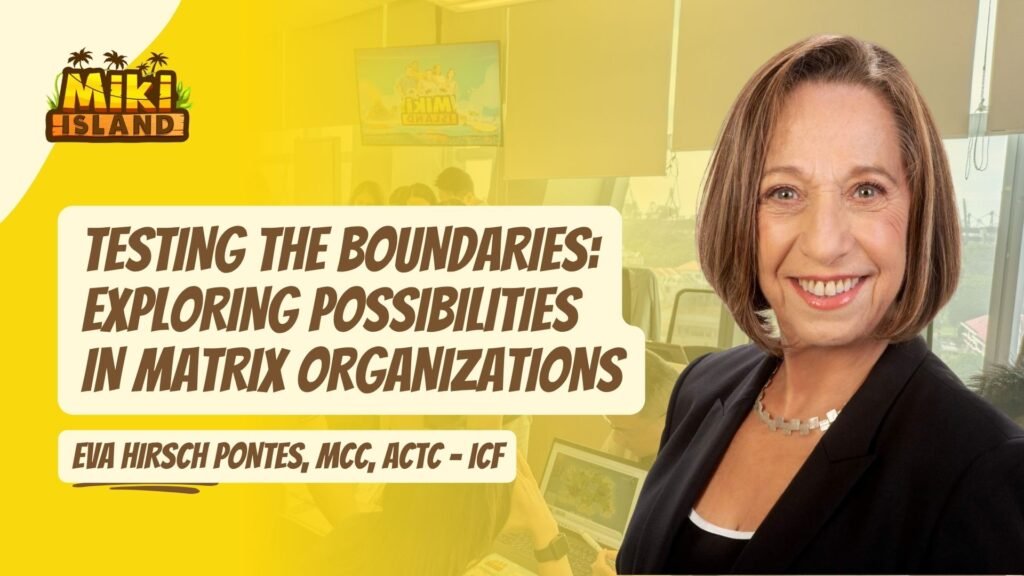
Testing the Boundaries: Exploring Possibilities in Matrix Organizations with Eva Hirsch Pontes

Key Takeaways

The Matrix Question 🧩

Leadership in a matrix organization carries an inherent tension. Executives may sit together as a leadership group while also holding distinct responsibilities for businesses, functions, geographies or other parts of the organization. At times, those responsibilities can be pursued relatively independently. At others, the work cuts across boundaries and requires genuine interdependence.

For an experienced professional bringing a systemic team coaching lens to such a group, an important question arises:

To what extent does the organizational system actually require these leaders to operate
as a team?

This was the question Eva Hirsch Pontes wanted to investigate as she prepared to facilitate a leadership retreat for the executive team of a major global organization. With this question in mind, she began by interviewing each participant individually.

Her inquiry sought to locate interdependence: where collective work was required, what it required from the group, and where individual or area-level action remained appropriate.

Enter Miki Island 🏝️

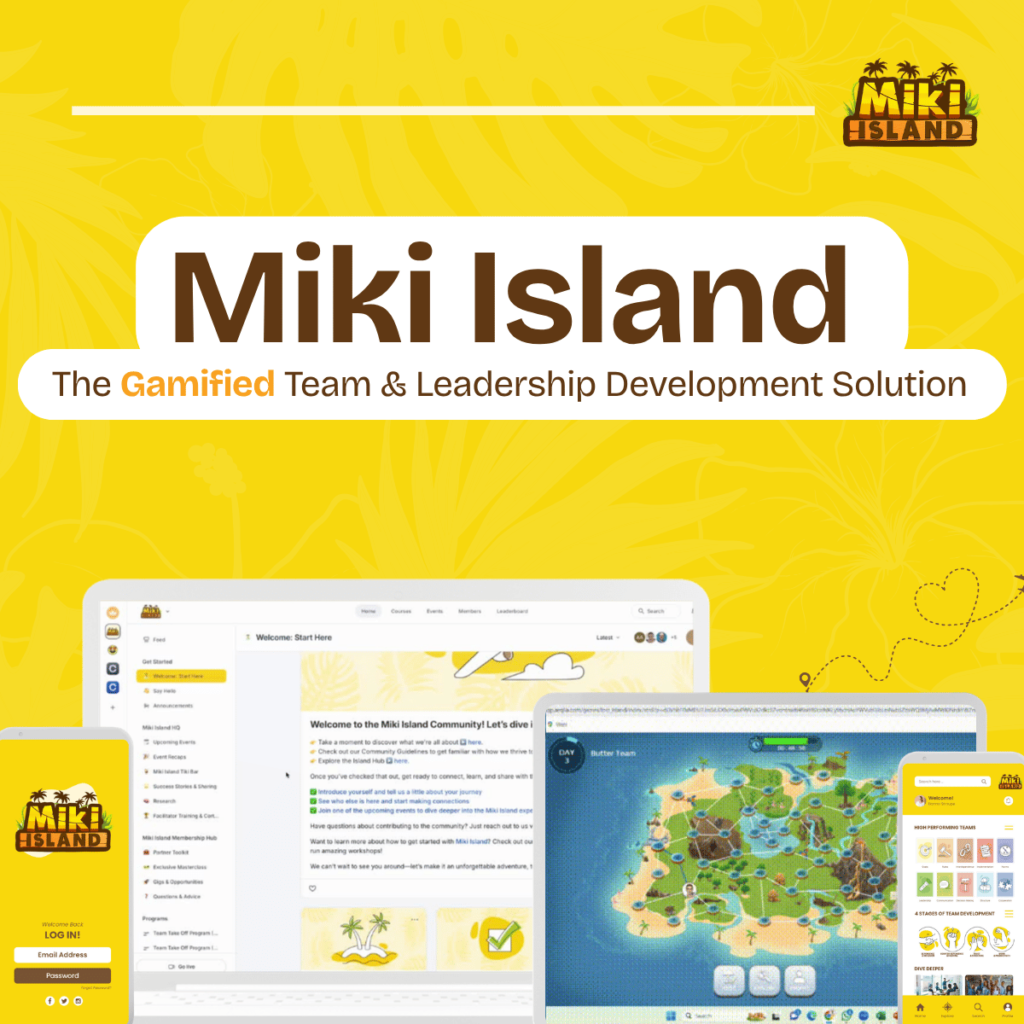
The executives were divided into three groups and began playing Miki Island, a fast-evolving simulation in which communication, resource allocation and decision-making unfold under pressure.

Before play even began, something unusual happened.

Members of one group questioned the boundaries they had been given. Were the three groups separate teams expected to pursue their own interests? Or could they see themselves as parts of a larger system and share resources?

They brought the question to Eva.

She did not answer it or steer them toward either competition or collaboration. The choice remained theirs.

They then approached the other groups and, with varying degrees of resistance, brought them on board. Before play began, all three groups had chosen to collaborate.

At the time of the retreat, more than 300,000 people had participated in Miki Island. This was the first time groups had chosen to collaborate with one another before play began.

As the pressure increased, participants continued to test what it meant to work across boundaries. At one critical moment, learning gathered in different groups was brought into shared view, making information distributed across the system available to everyone.

What the Simulation Made Visible 💡

What emerged during the simulation echoed a fundamental challenge of working in a matrix: the relevant boundary for collaboration is not always self-evident.

Leaders have to discern when responsibility can remain within their own area and when the work calls for greater interdependence. But boundaries do more than define where collaboration is required. They can also be questioned. Leaders may find possibilities for sharing information, resources and responsibility that are not prescribed by the formal structure or by established ways of working.

Miki Island gave participants an opportunity to experiment with this in real time. They could test where collaboration was possible, how far it could extend, what resistance it encountered, and what became possible when they chose to work differently across boundaries.

One Simulation, Different Lenses 🔍

The same Miki Island experience can illuminate very different aspects of collective work. Its richness lies partly in what participants bring to the experience and in what becomes visible as they respond to the challenges of the game. Depending on the purpose of the work, the facilitator can attend to different patterns and invite reflection through different lenses.

For this group, questions of boundaries, interdependence and the possibilities for collaboration became particularly salient.

One of the most revealing moments happened before the formal challenge had even begun. They had been placed into three groups, yet they questioned whether those given boundaries needed to determine how they worked.

In doing so, they surfaced a question that leaders in complex organizations repeatedly encounter:

What is the relevant boundary of the system for the work we need to do—and where
might we have room to reshape it?

Miki Island allowed them to explore that question through experience.

Conclusion

Scroll to Top
Seraphinite AcceleratorOptimized by Seraphinite Accelerator
Turns on site high speed to be attractive for people and search engines.