
Building Future-Ready Leadership in a World of Constant Change
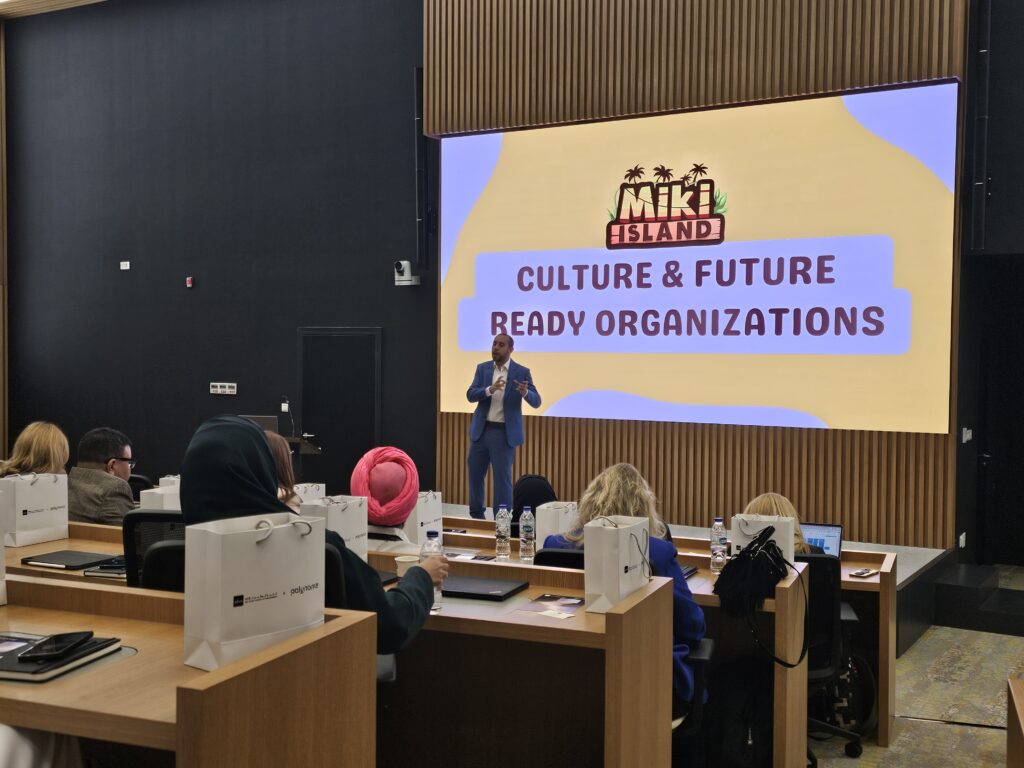
Picture taken from the Miki Island workshop with Polynome AI x Abu Dhabi School of Management for 40+ Chief AI Officers.
Building Future-Ready Leadership in a World of Constant Change
From Playing to survive to Playing to Win!
The context in which leaders operate today is defined by constant change. AI is reshaping industries, geopolitical shifts are redefining markets, and volatility has become the norm rather than the exception. In this environment, leadership is no longer about simply surviving uncertainty. It is about architecting what comes next — while still delivering results today.
Executive education and leadership development programs are feeling this pressure acutely. Senior leaders are expected to make faster decisions, manage competing priorities, and commit resources with incomplete information. Yet many development experiences still focus more on understanding complexity than on practising how leaders act within it.
The persistent gap between knowing and doing
Most executive education and leadership development programs already offer strong content. Leaders are exposed to proven frameworks, expert insights, and compelling case studies. The challenge is not a lack of knowledge or ambition.
The real gap lies between knowing what should be done and being able to do it when trade-offs are real, time is limited, and consequences matter. Leaders rarely get to practise decision-making under realistic conditions before facing those pressures in their organizations.
Bridging theory and practice
This is where experiential platforms such as Miki Island play a critical role. Rather than replacing theory, they help executive education and leadership development programs bridge the gap between insight and action.
By placing leaders in structured, decision-based environments, Miki Island allows participants to move beyond discussing strategy to experiencing it. Choices must be made. Priorities must be set. Trade-offs become unavoidable. And the impact of those decisions becomes visible.
Playing to survive versus playing to win
One of the most striking patterns that emerges in environments like Miki Island is how leaders approach uncertainty. Some default to playing to survive — protecting resources, avoiding conflict, and delaying commitment. Others begin to play to win — reallocating boldly, aligning around clear priorities, and acting despite ambiguity.
These patterns are difficult to surface in traditional executive education settings. They emerge through action. For program directors and HR leaders, this creates a shift from theoretical discussion to observable leadership behaviour.
Strategic thinking through pause, reflection, and replay
Miki Island intentionally builds in moments to stop and reflect. Leaders pause to assess the outcomes of their decisions, consider alternative paths, and adjust their strategic approach. The experience is also replayable, allowing leaders to test different strategies and learn through iteration.
This replayability strengthens strategic thinking over time. Rather than treating leadership development as a one-off intervention, executive education programs can use these cycles to develop sharper judgment and more adaptive decision-making.
Learning across multiple levels
Another strength of simulation-based approaches such as Miki Island is their ability to develop leadership capability across multiple levels at once. Leaders gain insight into their own decision-making style, risk appetite, and leadership identity. They also experience how alignment, prioritisation, and execution rhythms shape outcomes at the organizational level.
For executive education and leadership development programs, this creates a more integrated view of leadership — linking personal judgment with strategic and organizational impact.
Why practice changes behaviour
Practice forces leaders to confront the reality that not everything can be prioritized. It makes trade-offs explicit and consequences visible. Rather than reflecting on leadership in abstract terms, leaders experience how their decisions shape outcomes over time.
This is why practice-based learning is increasingly central to effective executive education and leadership development programs. Behaviour changes not because leaders are told what to do, but because they see the impact of their choices.
Stepping back from the experience
The real value of simulation-based learning emerges when leaders step back from the experience. Reflection connects decisions made in the simulation to real organizational challenges. Executive education contexts use this space to deepen strategic dialogue, while HR and L&D teams translate insight into concrete actions at work.
The simulation becomes a shared reference point — not an end in itself, but a catalyst for meaningful change.
From experience to sustainable capability
Simulations alone do not create future-ready leaders. But when embedded thoughtfully within executive education and leadership development programs, they create the conditions for learning that lasts.
In a world of constant change, leadership capability is built through practice, reflection, and iteration. The shift from playing to survive to playing to win begins with how leaders learn.
